


Animal Bites and How Tolerant Humans are of Them: Comparing Reptiles to Traditional Pets.
Introduction
As of 2026, in the UK, 62% of houses have pets and 500,000 snakes are kept as pets.1
Snakes are joint 6th popular pets behind dogs, cats, birds, fowl, and horses1. While dogs are still the most popular at 15.5m1, roughly 5% of UK households now have pet reptiles which has increased from 3.4% two years ago.2
However, more reptiles are being abandoned and the number increased by a third in the 3 years between 2012-20153. The reasons behind this can be a lack of education of the animal’s welfare needs3, the animal getting too big, cost4,5, and people getting bored with their pets. In 2011, the RSPCA collected 1390 reptiles - by 2014 the number had increased to 18533. Abandoning an exotic pet is illegal under UK law and you can be fined for it4.
Another issue that might lead to abandonment, can be fear of their pets3, possibly after being bitten. This research aims to find out if people who are bitten by their pet reptiles are more or less likely to abandon their pets in the environment, compared to traditional pet owners.
Hypothesis
More hospitalisations will occur from snake bites than dog bites, therefore making snakes get abandoned more often because of bites.
Null:
There is no difference between the number of snake and dog bites, and pet owners are not more likely to abandon one over the other.
Methods
I wanted to collect data from real-world people, instead of social media. So I brainstormed ideas for a questionnaire, and designed the questionnaire in Microsoft Forms. There was a mix of multiple choice and text answers.
Questions were designed to retrieve data on what people would do in case of an animal bite from a pet dog or snake. Would they rehome the animal, release it, euthanize it, or nothing?
The Questionnaire was sent to the general public in the UK and US via social media accounts. It was also sent to different shelters and organisations that care for reptiles and abandoned pets, for their knowledge. It was also shared among friends and family.
Results were gathered using Microsoft Forms and presented in charts by the software.
We used the results that we gathered from the questionnaire to add reliable sources of information to this research report.
Results & Discussion
We received 119 responses in total. Here is the information we gathered.

From the people who responded to the survey, roughly four times more people had dogs than snakes, compared to 31 times more in the wider UK1. This means that our sample perhaps has more snakes or fewer dogs than the UK average.

These questions are about if you have ever been bitten by your pet.
Dogs: Out of 119 responses, 40 dog owners said they had been bitten by their pet - this is out of 102 people who said they had a dog. This is 39.2%
Snakes: Out of 56 responses, 12 pet owners said they had been bitten by their pet - this is out of 23 people who said they had a snake. This is 52.2%
There are a couple of issues with these questions. Looking at the numbers, people have replied to questions that didn’t apply to them by mistake - eg 102 people said they had a dog, and yet 119 responded to the question about having dogs, which suggested some who didn’t have dogs didn’t read the question properly.
Secondly, “My family has” [been bitten] can be interpreted as “my family have been bitten by a pet that isn’t mine” and still ticked, and so this option should have been made clearer, because I meant it as “my family has been bitten by my pet” specifically. For this reason, I have not included these results. However, it is interesting to note that twice as many people have a family member that has been bitten by dogs compared to snakes. Although this could be because there are more dogs as pets than snakes, and also because dogs interact with more people and are more attached to their owners than snakes, so might bite those that aren’t as familiar to them.

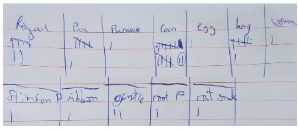
This question asked about the severity of the bite. Out of 54 dog bites, 8 resulted in hospital visits (14.8%). Out of 18 snake bites, 1 resulted in hospital (5.6%). This suggests that dog bites are more severe than the snake bites. However, our question about species of snake kept shows that the most popular is Cornsnake, followed by Royal pythons, and then Hognoses and various boas are joint third (Fig 4.) So the amount of hospitalisations are affected by the fact that none of the pet snakes are actually venomous.

This question asks about how many people would actually want to release their pet into the wild after being bitten. It shows that there is a slight difference between dogs and snakes - more people would be inclined to release snakes than dogs.
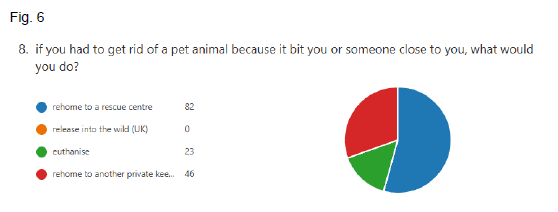
This question shows that most people would rehome their pet to a rescue centre, followed by another private keeper. People are more likely to euthanise their pet who has bitten, than they are to release it into the wild.
People were also asked what they did with their dog or snake after it bit them.
For dogs, the most common response was to discipline them and train them better, for example “Worked on better handling and training. It was not the dog's fault.”, “Got out of the situation, then reinforced rules through disciplinary techniques rather than harsh punishment”.
A few people had their dogs euthanised: “After the second bite and being looked at by a vet, the dog was put to sleep (euthanised)”, “The dog was put down”.
For snakes, the most common response was to return it to its vivarium and leave it alone for a while, for example “Snake was unhappy, so put back in her cage and left in peace and quiet”, “It was a mistaken feeding bite. She just realized her mistake and released eventually, and then everything went back to normal. Didn't even break my skin.”
In general, the snake responses seemed to not blame the animal, eg “Kept it and kept on loving it. It didn't mean to.” Whereas the dog responses seemed to be more influenced that it is the dog’s fault eg “Stopped playing with him immediately so he knew he had done wrong “.
Four dogs were euthanised, but no snakes were put down after biting.
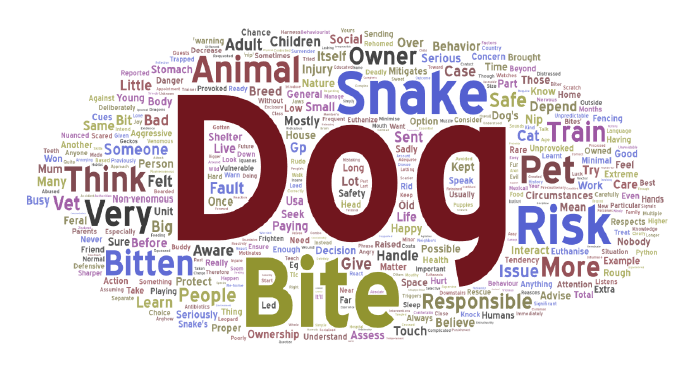

My final question was “Use this space to leave any other comments about how you feel about the risk of dogs or snakes as pets and what you would do if your pet bit you or someone else“. I took all of the responses and put them in a word cloud software, and it made a word cloud with the most popular words being the biggest. I then removed the words that were part of the question because they were the subject rather than the comments about the subject. This shows that the most popular themes are around the risks that come with pet ownership, being OK with being bitten, and knowing that it isn’t the pet’s fault. Also being responsible for your pet, and your dog’s training in particular. Some example quotes are:
“Dogs and snakes are animals and there is always a risk of being bitten, that is just one of the costs of owning them. Assuming the bite was unprovoked, I would not take any action - if it was unprovoked then I would speak to a vet or animal behaviourist to see if future bites can be avoided.”
“...people should be educated in how to handle their pets safely. I have trained my dog to not bite by respecting his space and learning his body language so I know when he feels comfortable, and when my snake bit me it was my own fault for not paying close enough attention at the time (most snake bites are mistaking hands for food, not the snake feeling defensive or aggressive). If I felt that my dog or snake were dangerous to other people I would be very careful about letting them near anyone.”
“It’s all part of responsible pet ownership and being aware of the risks of (and to) the animal of itself, other animals, and humans."
“Our snake isn’t venomous, so it’s more annoying than anything else when she bites and won’t let go. We’ve learnt to manage that and understand what motivates her to bite and then minimise that.”
Conclusion
My findings show that more people who own snakes experience more bites than people who own dogs. However, more dog bites result in hospitalisations than snake bites. This means my hypothesis “More hospitalisations will occur from snake bites than dog bites…”, was wrong, and so was my null hypothesis that “There is no difference between the number of snake and dog bites…”
Also, more dogs were euthanised than snakes (4:0) So we can conclude that the dog bites are more harmful and people act on them more than snake bites. I also wonder if small dog bites are under reported compared to snake bites, because people are more used to their dogs nipping and so don’t count it as a bite.
My findings also show that in theory more people would release snakes into the wild than dogs, but the likelihood of doing either in reality was low - most people would rehome their pets over releasing them into the wild.
This means my hypothesis “...snakes get abandoned more often because of bites.“ was wrong. And my null hypothesis that “...pet owners are not more likely to abandon one over the other.” was correct.
This is good news, because releasing pets into the wild can threaten native species and upset local ecosystems4,6. For example, invasive Burmese Pythons and Tegus can kill native animals and alter the food chain. They can do this by eating the small animals and birds that usually spread the seeds from the plants. So it is important that people don’t release their pets into the wild. It’s good that people who responded to this study wouldn’t release their pets.
More research needs to be done around the severity of the dog bite being reported (nip vs severe bite), and in future research, a bigger number of people responding would give better data. I have already mentioned how I would improve my survey questions for clarity, but I would also ask about people’s level of education around their pets, because it would have been helpful to know if they were reptile professionals with lots of experience or not when analysing their data.
This research does not provide support to the current arguments in UK Law for a “positive list” or “white list”7. As there isn’t a problem of people releasing their reptiles into the wild, a ban would not be needed to prevent this. A positive list is much more likely to make people release their animals into the wild out of fear of their pets being killed or taken from them. Research around attitudes about this would be a really good idea before changing the law.
My research shows that despite more snake owners being bitten by their pets, snake owners are more tolerant to being bitten than dog owners because more hospitalisation occur due to dog bites and more dogs are euthanised as a result of bites. In general people thought that being bitten by a pet was a normal part of all pet ownership, and they also thought that it was the responsibility of the pet owner to ensure the pet is well trained and cared for so that it reduced the chances of biting.
References
1. Statista.com, leading ten pets ranked by population size in the united kingdom 2026, and estimated pet ownership in the united kingdom 2026
2. Tansley, L. Pet Reptile Populations in the UK: Trends and Insights, Northampton Reptile Centre Blog, Feb 24th 2026. (https://www.reptilecentre.com/blogs/reptile-blog/pet-reptile-populations-in-the-uk)
3. Birchley, E. Rise in Number of Abandoned Reptile Pets,Sky News UK, 16th May 2015 (https://news.sky.com/story/rise-in-number-of-abandoned-reptile-pets-10359263)
4. Pets at Home Website, Foster Snake: Why Many Reptiles are Being Abandoned in the Wild, 25th March 2026 (https://www.pets4homes.co.uk/pet-advice/snakes-on-the-loose-why-so-many-reptiles-are-being-abandoned-in-the-wild.html)
5. McCamley, F. Energy Costs Force Owners to Give up Their Pet Reptiles, BBC website, 10th June 2022 (https://www.bbc.co.uk/news/uk-england-61720142)
6. Ecological Impacts of Invasive Reptiles, Nature Index, (https://www.nature.com/nature-index/topics/l4/ecological-impacts-of-invasive-reptiles)
7. Don’t Pet Me: A Campaign to Ban Your Pets, Responsible Reptile Keeping.org 2026, (https://responsiblereptilekeeping.org/dont-pet-me)
Student Research completed by TW as part of the ASDAN CoPE Level 2 Qualification Unit R2 and Module 5 The Environment


Comments