


New Animals at The Reptile Academy!
It has been around 10 months since I was last at The Reptile Academy, so it is good to be back! A lot has changed since I was last here and there are plenty of new residents for me to meet. Here are just a few of them.
We have had three new chameleons make themselves at home. Two of these are Macho and Pembe, Jackson’s chameleons. They are mainly arboreal, meaning they spend most of their time in trees, so you will normally find them sitting or climbing on branches in their enclosures.

Male Jackson’s chameleons
Unlike Macho and Pembe are two of the new female Jackson’s chameleons at The Reptile Academy, male Jackson’s chameleons grow a triceratops style horn. Their enclosure provides plenty of branches for climbing.
The other chameleon is Thor, a Yemen veiled chameleon. He is much larger and lives in a smaller enclosure. To give him more opportunities to explore, there is a rope system set up around the building which he can climb on. This is a form of environmental enrichment, as it gives Thor opportunities to climb, explore and use natural behaviours outside of his normal enclosure.
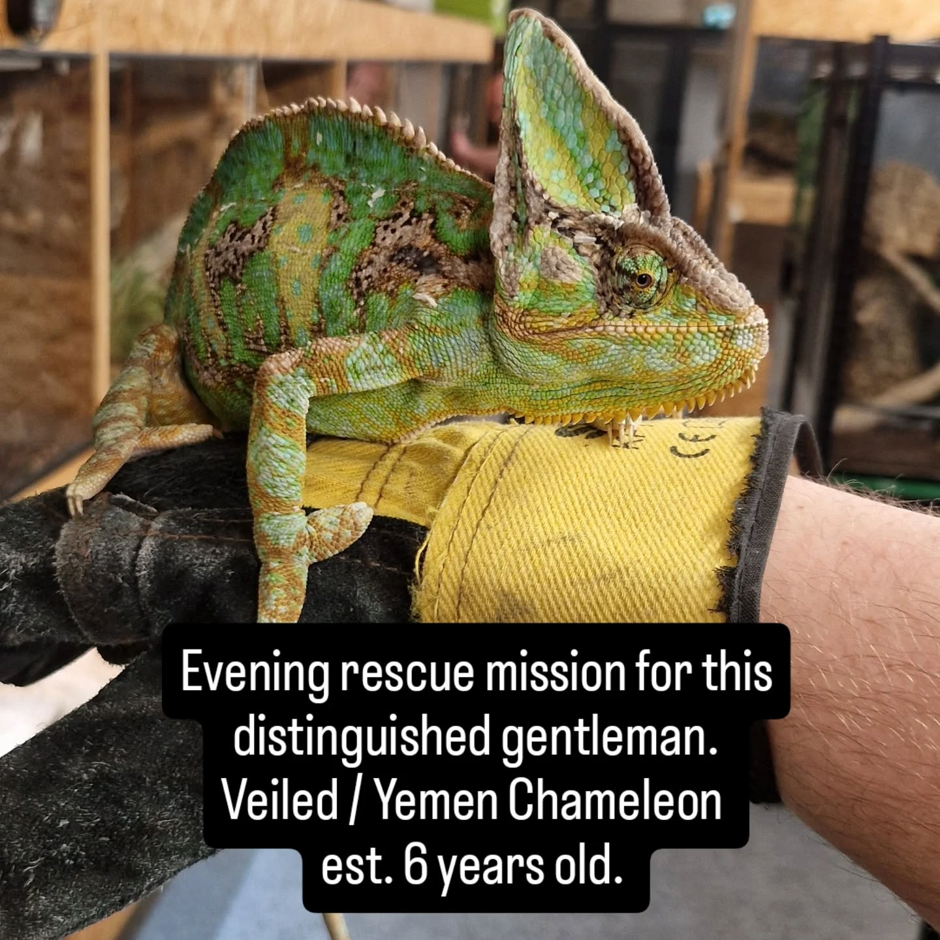
Thor Yemen veiled chameleon
Thor was rescued because his owners we too unwell to look after him. He explores the rope system to provides environmental enrichment by giving him more opportunities to climb and explore. Photo taken at The Reptile Academy
We have also introduced some new amphibians to The Reptile Academy. Two of these are golden mantella frogs, Goldfinger and Odd-job. They are much smaller than you might expect for a frog and are also a critically endangered species. This makes golden mantellas particularly important animals to have in captivity, as captive populations can help protect the species from completely disappearing.
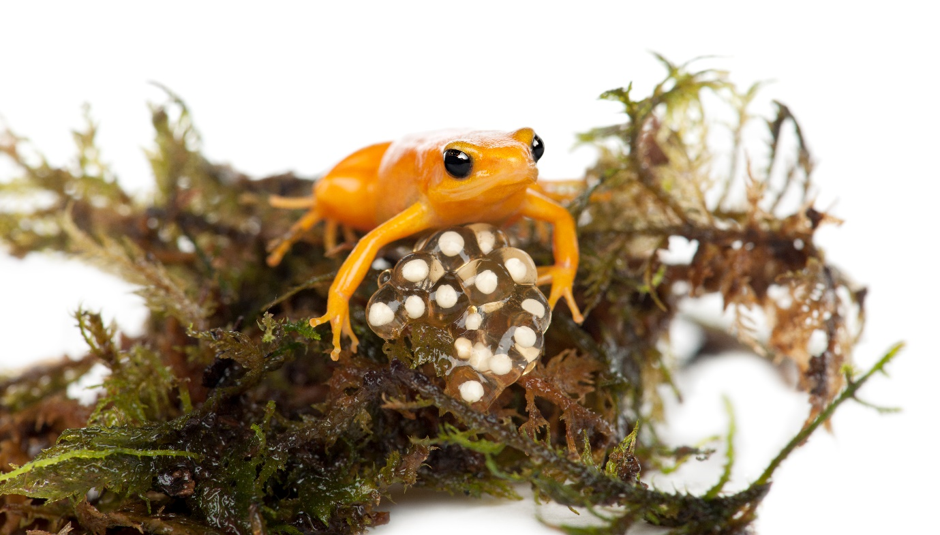
Goldfinger a golden mantella frog
Golden mantellas are critically endangered in the wild, making captive populations particularly important, so we encourage them to breed at The Reptile Academy.
The other amphibians include European green toads and four new marine toads, called Chaos, Inferno, Rebel and Anarchy. I think these are some pretty cool names!

European green toad
Toads have parotoid glands which can produce defensive toxins called bufotoxins. These are the only species at The Reptile Academy which are native to Europe.
One interesting thing that these toads have in common is that they can produce bufotoxins. These are defensive toxins produced from glands in their skin, particularly the large parotoid glands on their shoulders. This helps to protect the toads from predators which might otherwise try to eat them.
We also have loads of new geckos. My personal favourites are the Henkel’s leaf-tailed geckos. One of their most interesting adaptations is their amazing camouflage. Their colours, patterns and body shape help them look like tree bark, making them very difficult to spot when they are sitting still. Their flattened bodies and tails also help to break up their outline so predators have a harder time seeing them.
I think they are one of the most interesting new animals because you can look straight into their enclosure and still struggle to find them!

One of our Henkel Leaf Tail Geckos at The Reptile Academy
They flatten their bodies to camouflage and drink from rain or mist! Photo taken at The Reptile Academy
Overall, every animal here is unique and interesting in their own way. I’ve only listed several of the new species here at The Reptile Academy, and after being away for 10 months there has definitely been a lot for me to catch up on.
If you’d like to find out more, give us a visit and see if you can spot the leaf-tailed geckos for yourself!
Blog by Caoimhin D’Errico
Student at The Reptile Academy
Keywords
Arboreal
An animal that spends much of its time living or climbing in trees.
Enrichment
Something provided to an animal that encourages natural behaviours and gives it opportunities to explore or interact with its environment.
Critically endangered
A conservation status for a species that is at an extremely high risk of becoming extinct in the wild.
Captive population
A group of animals of the same species that are kept and cared for by people rather than living in the wild.
Bufotoxins
Defensive toxins produced by some toads that help protect them from predators.
Parotoid glands
Glands found behind the eyes of many toads which can produce defensive secretions.
Camouflage
Colours, patterns or body shapes that help an animal blend into its surroundings.
Adaptation
A feature or characteristic that helps an animal survive in its environment.
Leaf-tailed gecko
A group of geckos with adaptations that help them resemble leaves or tree bark and remain camouflaged.
References and Further Reading
I used the following to check some of the information in this blog. You can also use them to learn more about the animals and topics mentioned.
IUCN Wildlife in a Changing World. Conservation status of the golden mantella (Mantella aurantiaca), which is listed as Critically Endangered. IUCN
Smithsonian’s National Zoo Henkel’s Leaf-tailed Geckos National Zoo
RSPCA Reptile Enrichment RSPCA Australia
The Reptile Academy Magazines The Reptile Academy Magazine (The Reptile Academy Magazine Volume 1 (May 2020 - April 2021)) : Weeks AMRSB, Jake, Tyler AMRSB, Connor, Weeks, Gary, Whelan, Connor, Hoile, Asia, Porter, Katie, Kenneavy, Curtis, Rheins, Jonathan, Hopkins, Rosie, Miles MRCVS, Dr. Sonya: Amazon.co.uk: Books
The Reptile Academy Library Librarika: Catalogs
Please provide feedback


Comments